

Close the loop from schedule to payment
The last mile of every project is paperwork. Atelier generates proposals and invoices from the work you've already done — so nothing gets typed twice.
Invoicing
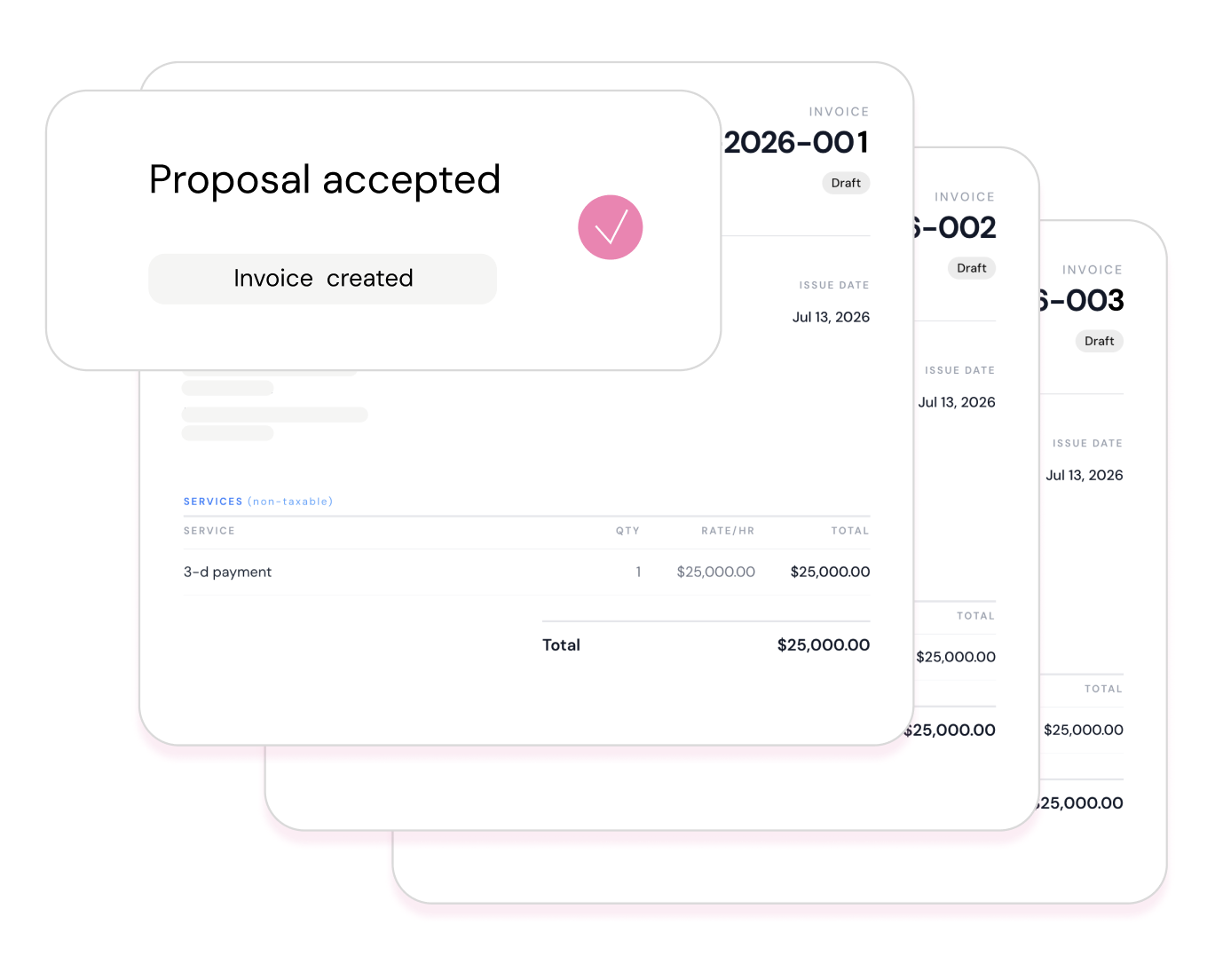
Invoices without double entry
Generate client invoices from the same source of truth, with markup and milestones applied. What the client approved is what they’re billed.
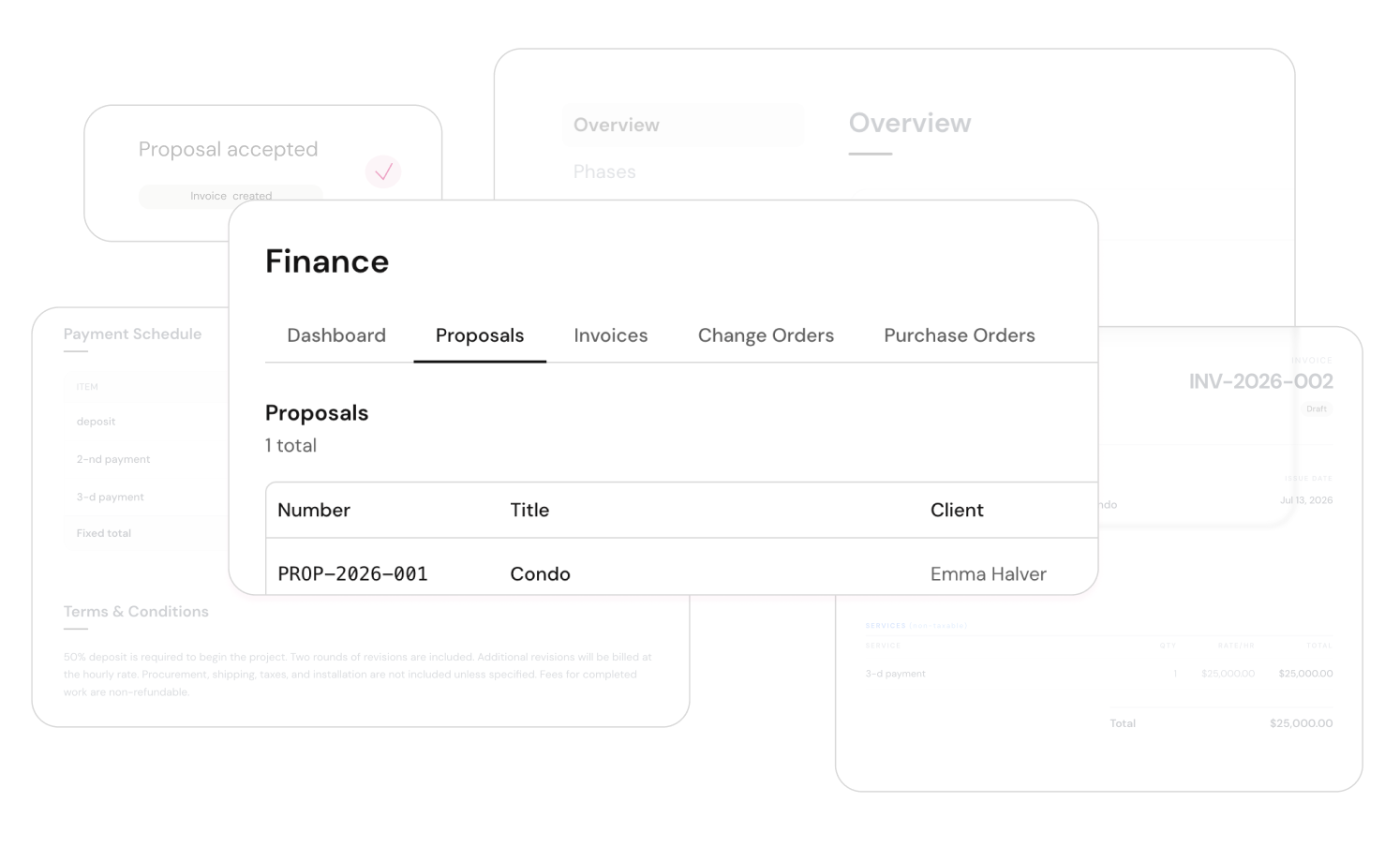
Proposals straight from schedules
Your FF&E schedule already holds the products, quantities, and prices — Atelier turns it into a client-ready proposal without re-entering a line.
One-link client sign-off
Send a proposal as a live link. Clients review, comment, and accept without an account — and the issued proposal stays as the document of what was agreed.
Works with your accounting
Atelier is not an accounting replacement — QuickBooks and Stripe integrations are on the roadmap, so invoices flow into the books you already keep.
A design invoice is not a normal invoice
This is why generic invoicing tools quietly fail designers, and the differences are structural rather than cosmetic.
There are two prices for every item — a list price, and a client price after your trade discount and markup. The client must see one and never the other. A tool with a single price field forces you either to expose your margin or to keep the real numbers somewhere else, and “somewhere else” is invariably a spreadsheet that stops matching your invoices by week four.
Discounts vary per vendor account, not per studio — sometimes several accounts at the same supplier. Money moves before goods do, so a deposit needs to attach to specific items rather than sitting as a lump sum. And billing is progressive and mixed: a design fee by phase, plus goods at order and delivery, plus shipping and tax that arrive late and change.
None of that is exotic. It is the standard shape of an interior design or architecture practice — it is simply not what general invoicing software was built for.
Where your books still live
Worth being direct, because it is the most expensive assumption to get wrong when choosing a platform: Atelier is not an accounting replacement.
It produces the client-facing side — proposals, invoices, the approval record, the money math on every line — and QuickBooks and Stripe integrations are on the roadmap so that output flows into the books you already keep. What it does not do is general ledger accounting. If your real bottleneck is the ledger rather than the projects, a platform built around full accounting is the better buy, and we would rather say so here than have you find out later.
Related reading
- Invoicing and proposal software compared — including which platforms include a general ledger and which do not
- Procurement and purchase order software — how deposits, partial deliveries and trade accounts should behave
Frequently asked questions
How does Atelier generate a proposal?
From your FF&E schedule. The schedule already holds the products, quantities and client prices, so the proposal is produced from that data rather than rebuilt in a separate document. Nothing is typed twice, and when a client swaps an item the change propagates instead of requiring three documents to be edited by hand.
Do clients see my trade discount or markup?
No. List price and client price are separate values in Atelier, with your trade discount and markup calculated behind them. The client sees the client price. This is exactly where generic invoicing tools cause trouble — a single price field forces you either to expose your margin or to keep the real numbers in a spreadsheet that stops matching your invoices.
Can I bill in stages or take a deposit?
Yes. Payment milestones are built in, so you can bill a deposit before ordering and the balance at or after delivery without rebuilding the invoice each time. Because items carry their own state through the procurement pipeline, you can also see which items a payment actually covers rather than tracking a lump sum against the project.
Does Atelier replace QuickBooks or my accountant?
No. Atelier is not an accounting replacement. It generates client-facing proposals and invoices from the work you have already done, and QuickBooks and Stripe integrations are on the roadmap so those flow into the books you already keep. If you need full general ledger accounting inside the same platform, Studio Designer is the honest recommendation.
How do clients accept a proposal?
Through a live link — no account, no login, no attachment. They review, comment and accept, and the acceptance is recorded against the proposal you issued, which is the document that states scope, products and prices. When a proposal is accepted the invoice follows from the same source of truth, so what the client agreed to is what they are billed.
What does Atelier cost?
Atelier is $39 per seat per month billed annually, or $49 billed monthly, with every feature on every seat and 150 AI credits per seat pooled across the studio. There is a free trial with no credit card required and no onboarding fee. Proposals and invoicing are included rather than sitting behind a higher tier.
Spend your time designing, not data-entering
Atelier speeds up your boards, forecasts your budgets, and takes the busywork off your plate — so you can focus on the work only you can do.
No credit card required.