

From specified to paid, in one pipeline
Procurement is where design projects lose money quietly. Atelier tracks every item through its whole life, with the trade discounts, markup, and tax math built in.
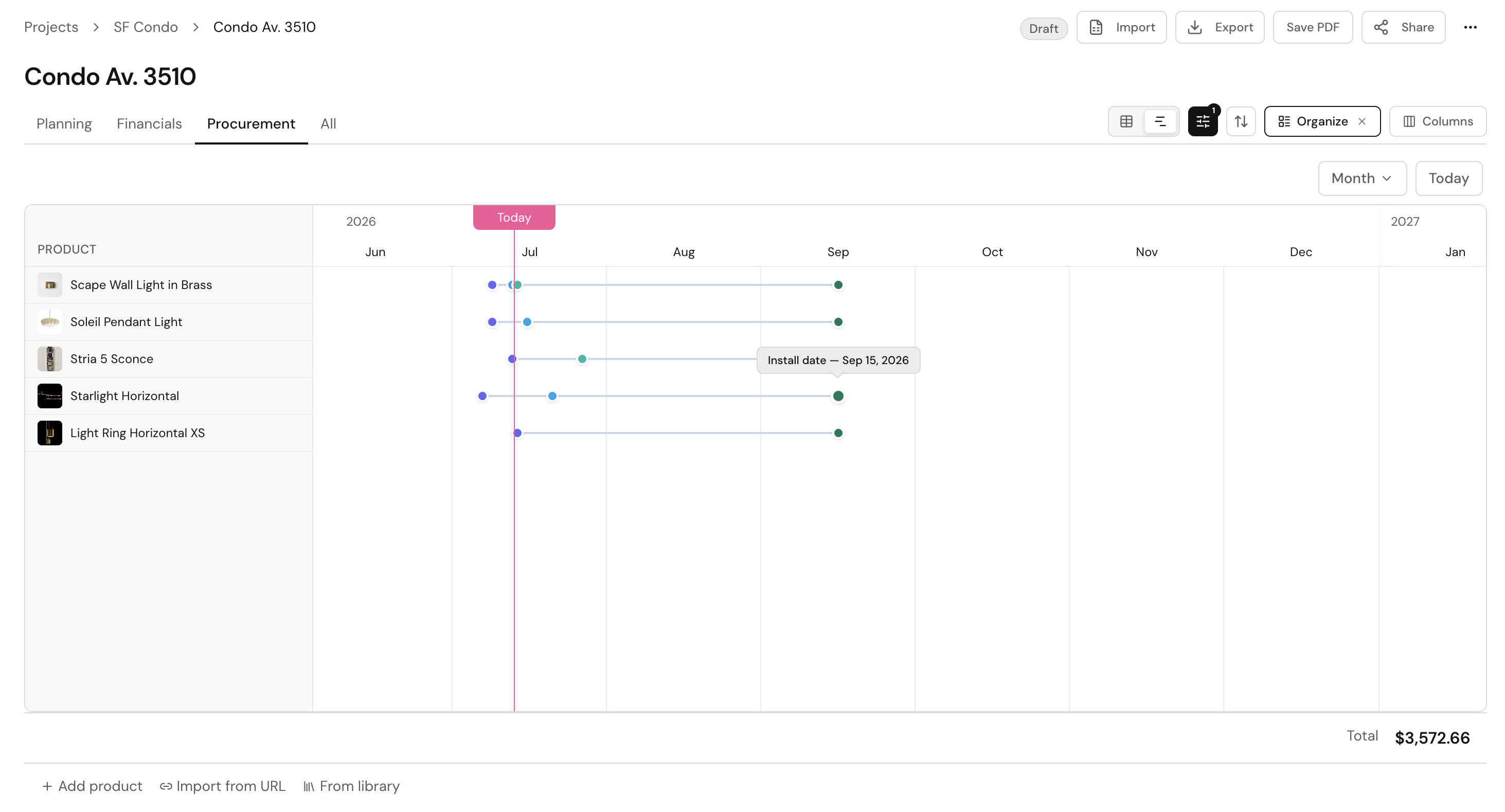
The full lifecycle, tracked
Every FF&E item moves through one pipeline: specified → ordered → in transit → delivered → installed → invoiced → paid. You always know where every piece stands.
Markup, discounts, shipping, tax
Real procurement math built in — client-facing markup, trade discounts, shipping, and tax on every line, so your margins are visible instead of buried in a spreadsheet.
Trade-aware vendor management
Multiple trade accounts per vendor, each with its own discount and login. Atelier applies the right account to the right project automatically.
Built for real studios
Roles and permissions, payment milestones, and time tracking — the operational backbone a working studio needs, in the same place as the boards.
Procurement errors do not announce themselves
Specification errors are visible. You order the wrong lamp, it arrives, everyone sees it.
Procurement errors are not. A trade discount applied at the wrong rate. A deposit that was never drawn against. Shipping charged to the studio instead of the client. A backordered item still showing as ordered three weeks after the vendor cancelled it.
Each one is small. None of them announces itself. They surface at the end of a project when the margin is thinner than the schedule said it would be — and by then, working out where it went costs more than it recovers.
That is the case for tracking state per item rather than per order, and for keeping the money math on the line rather than in a spreadsheet alongside it.
Where Atelier fits, and where it does not
Atelier is built for interior designers and architects running residential and boutique commercial work — studios where the designer is also the buyer, and where speed and low overhead matter more than procurement governance.
It is not an accounting system. Proposals and invoices generate from your schedules and the pipeline tracks money moving through a project, but your books stay in QuickBooks or Xero — QuickBooks and Stripe integrations are on the roadmap. If the honest diagnosis is that your ledger rather than your projects is the problem, a platform with full general ledger accounting is the better buy.
It is not an enterprise procurement system. Hospitality and large commercial projects need approval chains, bid comparison and audit trails at a scale that would be pure overhead for a design studio. Tools like Fohlio and Gather exist for that work, and they are the right answer there.
Related reading
- Procurement and purchase order software compared — including a five-step test for partial deliveries and substitutions
- Invoicing and proposal software — the design-specific billing math generic tools miss
Frequently asked questions
What does Atelier track for each ordered item?
Every FF&E item moves through seven states — specified, ordered, in transit, delivered, installed, invoiced, paid — tracked per item rather than per order. That matters because orders split constantly: a single status on a purchase order cannot represent a half-delivered one, which is the routine case rather than the exception.
How does Atelier handle trade discounts?
You can hold multiple trade accounts per vendor, each with its own discount and login, and Atelier applies the right account to the right project automatically. A single studio-wide discount field does not survive contact with reality, since rates differ by supplier and often by account type within the same supplier.
Can I see margin per item?
Yes. List price and client price are separate values, with your trade discount, client-facing markup, shipping and tax calculated on every line. Margin is visible per item as you build the schedule rather than discovered at the end of a project, which is when procurement errors normally surface and are least recoverable.
What happens when a vendor ships only part of an order?
Because state is tracked per item rather than per order, an order can split — some items delivered, others still in transit or backordered with a revised date — without losing the connection to the original purchase order or the client invoice. Partial shipments are routine, so this is worth testing in any tool you evaluate.
Does Atelier replace QuickBooks?
No. Atelier is not an accounting system and is not trying to be one. It generates proposals and invoices from your schedules and tracks the money moving through a project, but your books stay in QuickBooks or Xero — integrations with QuickBooks and Stripe are on the roadmap. If you need a full general ledger inside the same platform, Studio Designer is the honest recommendation.
Is Atelier suitable for hospitality or large commercial procurement?
Generally no. Atelier is built for residential and boutique commercial studios, where the designer is also the buyer and speed matters more than governance. Hotel, multi-unit residential and large commercial work needs formal approval chains, bid comparison across vendors and audit trails — that is what tools like Fohlio and Gather are built for, and they are the right answer at that scale.
Spend your time designing, not data-entering
Atelier speeds up your boards, forecasts your budgets, and takes the busywork off your plate — so you can focus on the work only you can do.
No credit card required.